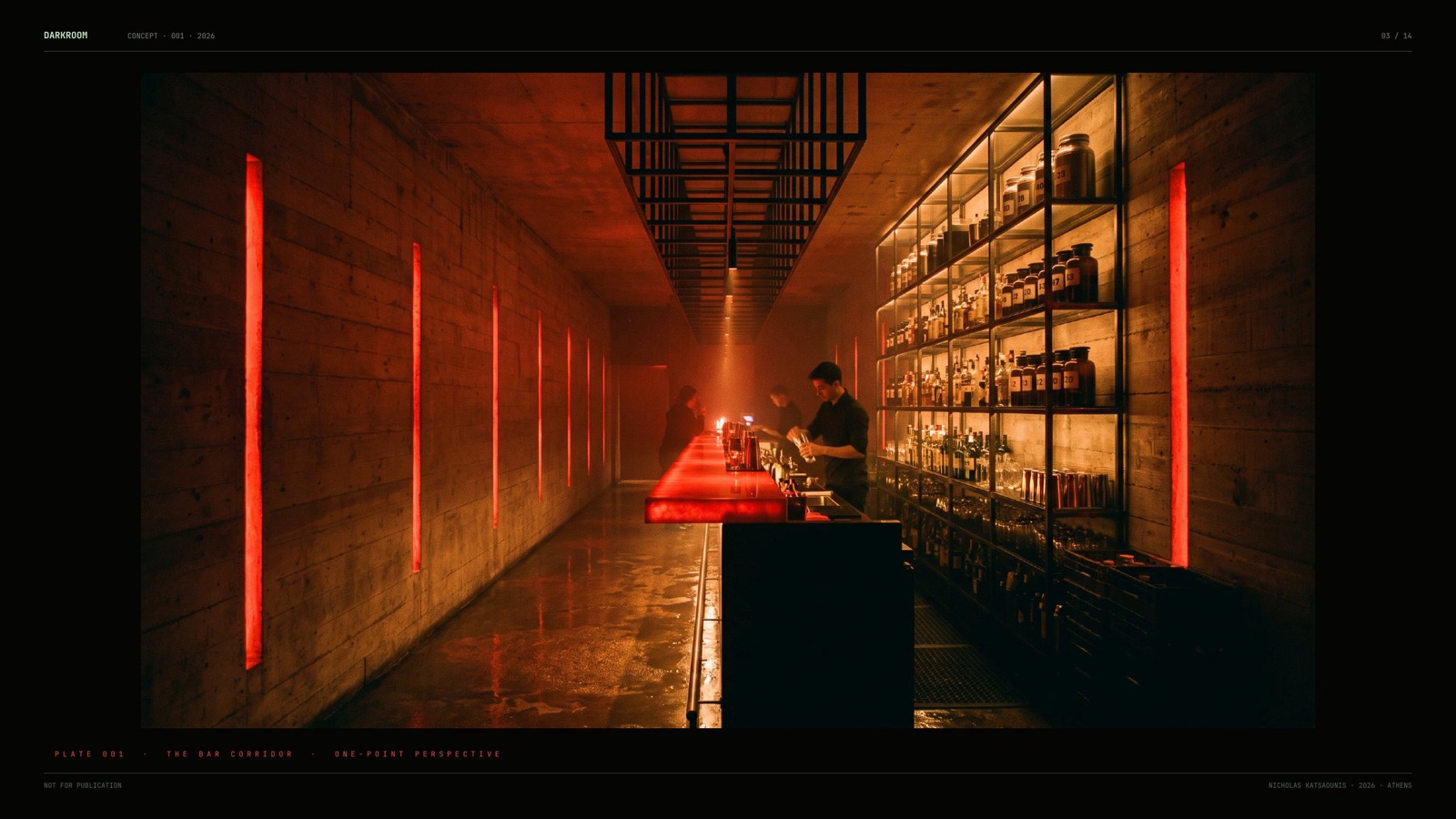
PLATE 001 · THE BAR · ONE-POINT PERSPECTIVE
Darkroom is a 22-metre bar flanked by eight cylindrical private rooms. Each pod is themed around a single social micro-ritual — the confession, the make-out, the private phone call, the smoke, the record, the edit. Doors rotate. Rooms are booked by the half-hour. Between them, a red-lit corridor lit like a photographer's safelight — the only place you can meet a stranger before the negative develops.
The bar is the darkroom. The pods are the frames. The night is the exposure.
Dark oak, gothic grille, one candle. A single seat facing the wall. Booked alone or in pairs. A resident house priest — actor, not clergy — takes confessions Fridays between 22:00 and 02:00. There is no absolution. There is a photograph.
Oxblood velvet walls, one blush leather banquette, no mirror. Lit warm. Bookings are 20 minutes maximum and require two names on the door. This is not a sex club. This is the seat inside the movie you didn't get to be in.
Walnut paneling, Bakelite rotary phone, a working landline that dials one number — the one you write on the card when you check in. Faraday-shielded. Your device does not work in here. The call is metered.
Nicotine-plaster walls, brass ashtrays, a red porthole cut through concrete. Filtered to legal air and vented up 4 storeys. Cigars, pipes, cigarettes. Every ashtray is dated. The room turns over every 90 minutes for filtration.
A perfectly cylindrical infinite mirror. Floor is red. Ceiling is red. Only walls reflect. Motion-triggered internal LED slit reveals your silhouette in soft red edge-light. This is the pod couples fight in and reconcile in — which is why the door only opens from the inside.
Klipsch La Scala corner horns. Two Eames chairs. Technics SL-1200 with a resident selector who does not take requests. Menu is a stack of jackets. You choose one. It plays A-side to Z. You cannot skip. You cannot talk over it.
A working 1970s Moviola upright flatbed. Steenbeck rolls of anonymised footage from every previous night at Darkroom. Grease pencils, splicing tape, a bin. You cut. Whatever you cut plays on the bar's back wall at 04:00. Your name goes on the reel.
Two chairs, one small table, one lamp. No music. No decor. Bookings are 25 minutes and require two people who checked in together. This is the pod where deals close and where relationships open. Booked five weeks out. Everywhere.
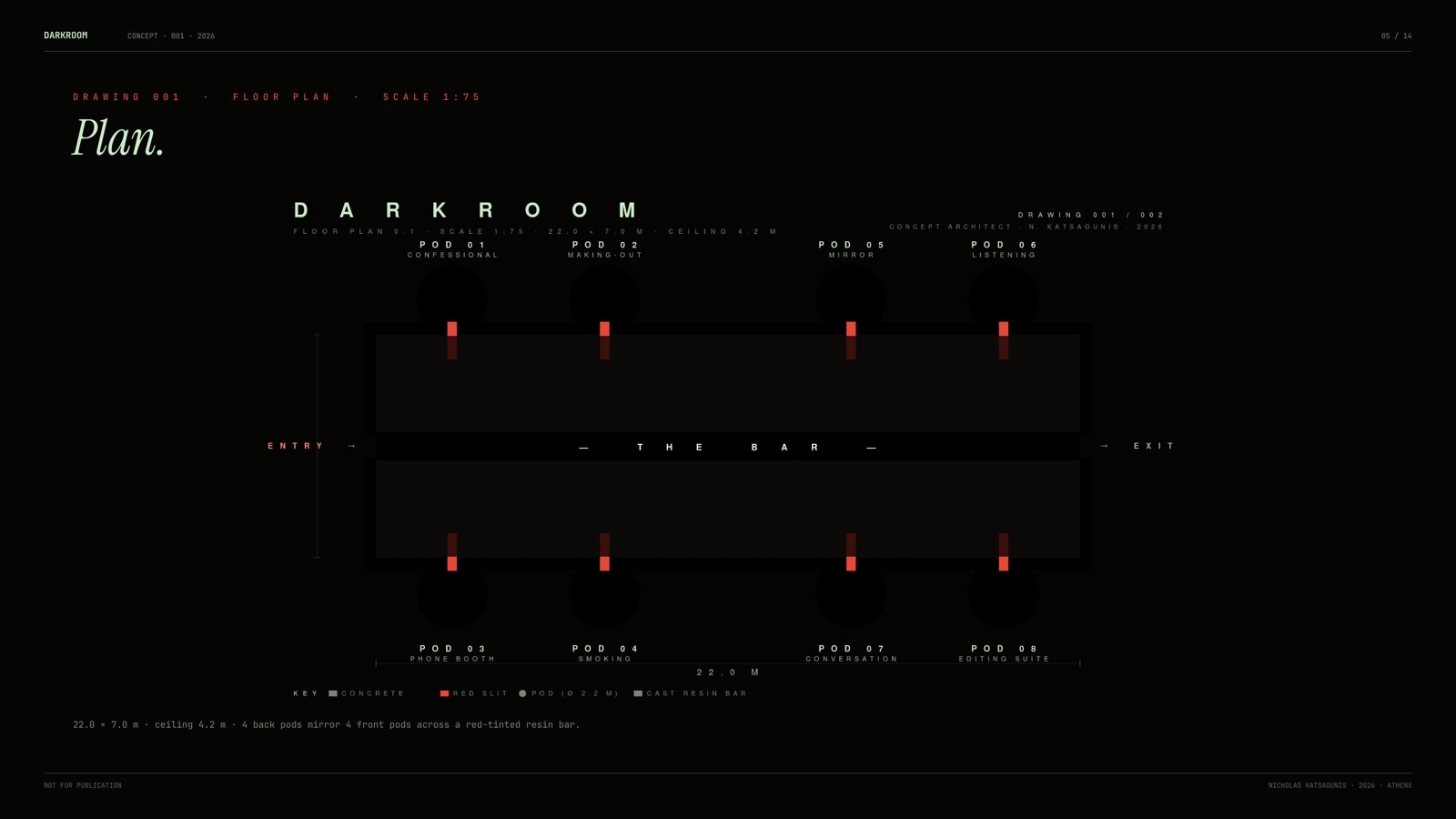
Floor plan 0.1 · scale 1:75 · 22.0 × 7.0 m · ceiling 4.2 m. Four pods mirror four pods across a red-tinted resin bar. Entry left, emergency exit right. All eight pods reach the corridor through a 22 mm × 2.2 m red safelight slit.
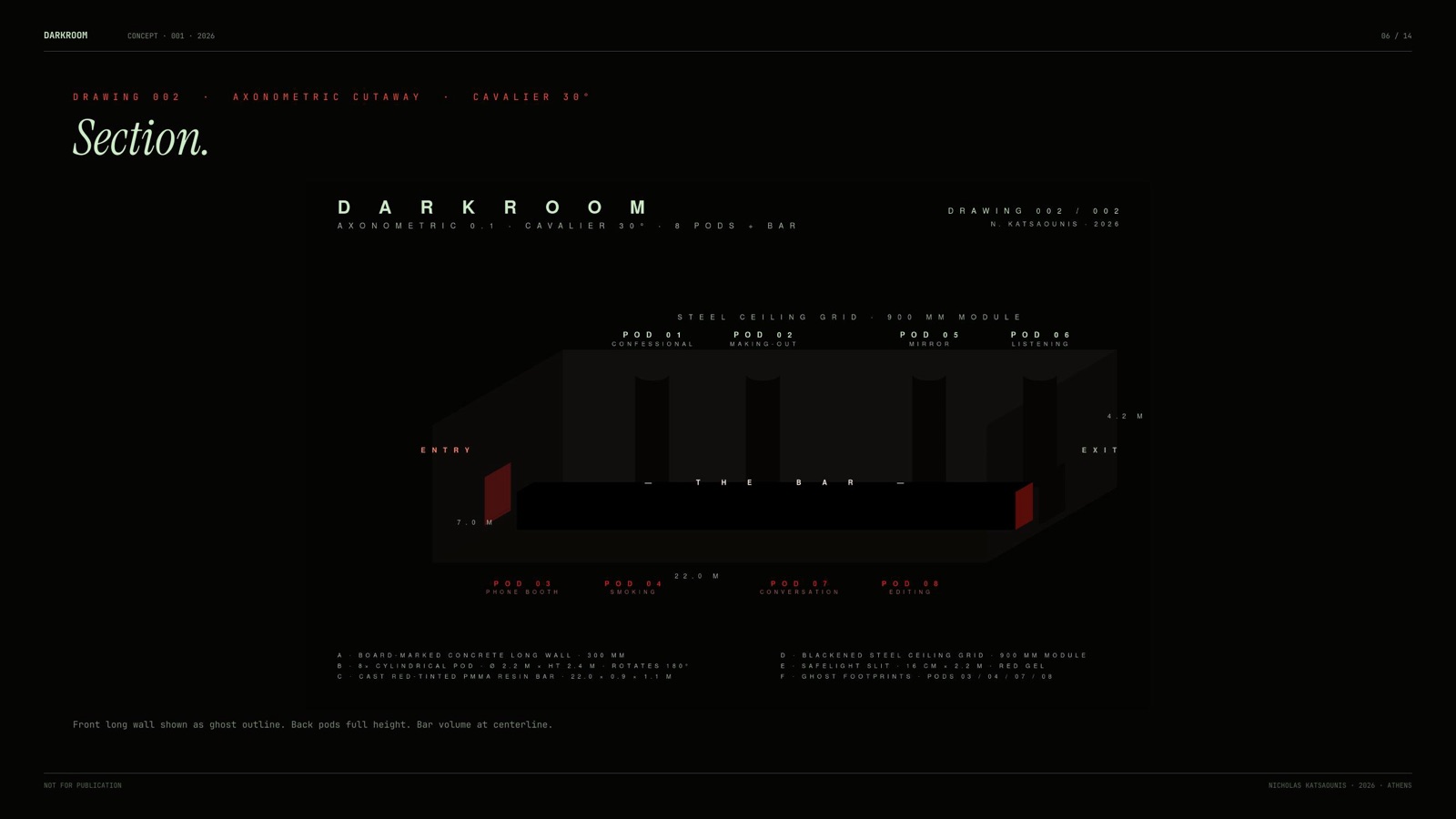
Cavalier 30° axonometric cutaway. The front long wall is shown as ghost outline so the four back pods and the bar volume read at full height. Cylinders are Ø 2.2 m × 2.4 m tall, rotating 180° on a silent belt-driven slewing bearing.
I started drawing this on a napkin in Athens in June. The napkin had a red ring on it — coffee, not wine — and the ring reminded me of the safelight in the darkroom I worked in during film school. That's where the whole thing came from. Not a bar. A safelight.
The premise is this: modern nightlife is a public performance under fluorescent light. Everyone is on camera. Everyone is on their phone. Everyone is performing the version of themselves that will hold up in the group chat tomorrow. There is no room, in the entire architecture of a modern bar, that permits the small private acts that used to be what nightlife was for — the confession, the make-out, the phone call, the smoke, the record played too loud, the argument, the reconciliation. All of them have been evicted by the phone camera and the open floorplan.
Darkroom is what you get if you carve them back in.